
Behind-the-Scenes Look
A poem from the podcast

Hi, Friend.
Happy New Year! I’m writing to you from bed where I’ve been holed up, ill, for the past week. I’ve been itching to write to you, and I’m finally feeling my mind come back—what a good feeling that is!—so today’s the day. As you know, I’ve been the host of The Slowdown since August. It’s been a joy and a privilege to share a poem and a moment of reflection with you each weekday. If you haven’t yet subscribed to our newsletter, you can do so here, and the poems will come right to your inbox, along with an abridged version of my introduction. We all need more poetry in our lives, frankly.
One of the things I love about the podcast is that it gives me an opportunity to shine a light on other poets. Each script I write introduces the day’s poem; it’s the opening act, but the poem itself is the headliner. The poem, of course, is the star! As I was telling our senior producer, Myka Kielbon, sometimes I wish I could stick around a bit afterwards and talk about what drew me to the poem, or point out what I specifically admire about it. I thought out loud to Myka during one of our recording sessions: “What if I could find a home for something like that on my Substack?”
So here we are, and that’s what I’m experimenting with: a series of posts in which I say a bit more about the poems I select for the show, and what I admire about them. I’m not an authority on anyone’s writing but my own—and even that is up for debate, as so much of our work is intuitive and can remain mysterious even to us—but I come to these texts as a reader, a fellow poet, and a teacher. In fact, for those of who are teachers, I think The Slowdown would be enormously useful in the classroom. Listen to daily episodes as a way to set the stage for student writing, or to introduce a writing prompt related to that day’s poem.
Let’s start with “Lamb” by Richie Hofmann. I’m going to link to the poem on the Academy of American Poets site here as well, because it includes some context from Hofmann that I think readers will find useful, and a reading by the poet himself. Here is our episode, with the poem below it.
Lamb
by Richie Hofmann
I had a lamb I brought everywhere
who only had one eye.
At the train stations,
all the grown-ups would say, be mindful
of your things, little boy,
someone will steal right out of your pocket
or take the watch off your wrist.
My dad had a beautiful overcoat.
The lamb’s white fur got smudged.
My brother was a baby,
and in the restaurants,
the old waiters would pick him up
and kiss him again and again on the cheek
with their mustaches
and tell my parents
that they promised they would bring him back in a minute
but now they needed to show the chef.
I don’t remember when the eye became unglued
and who knows where it went.
On long train rides,
I remember falling asleep,
putting my finger in the hole where it used to be.
Once he had to go in an overhead bin,
and he was freezing when I kissed him again.
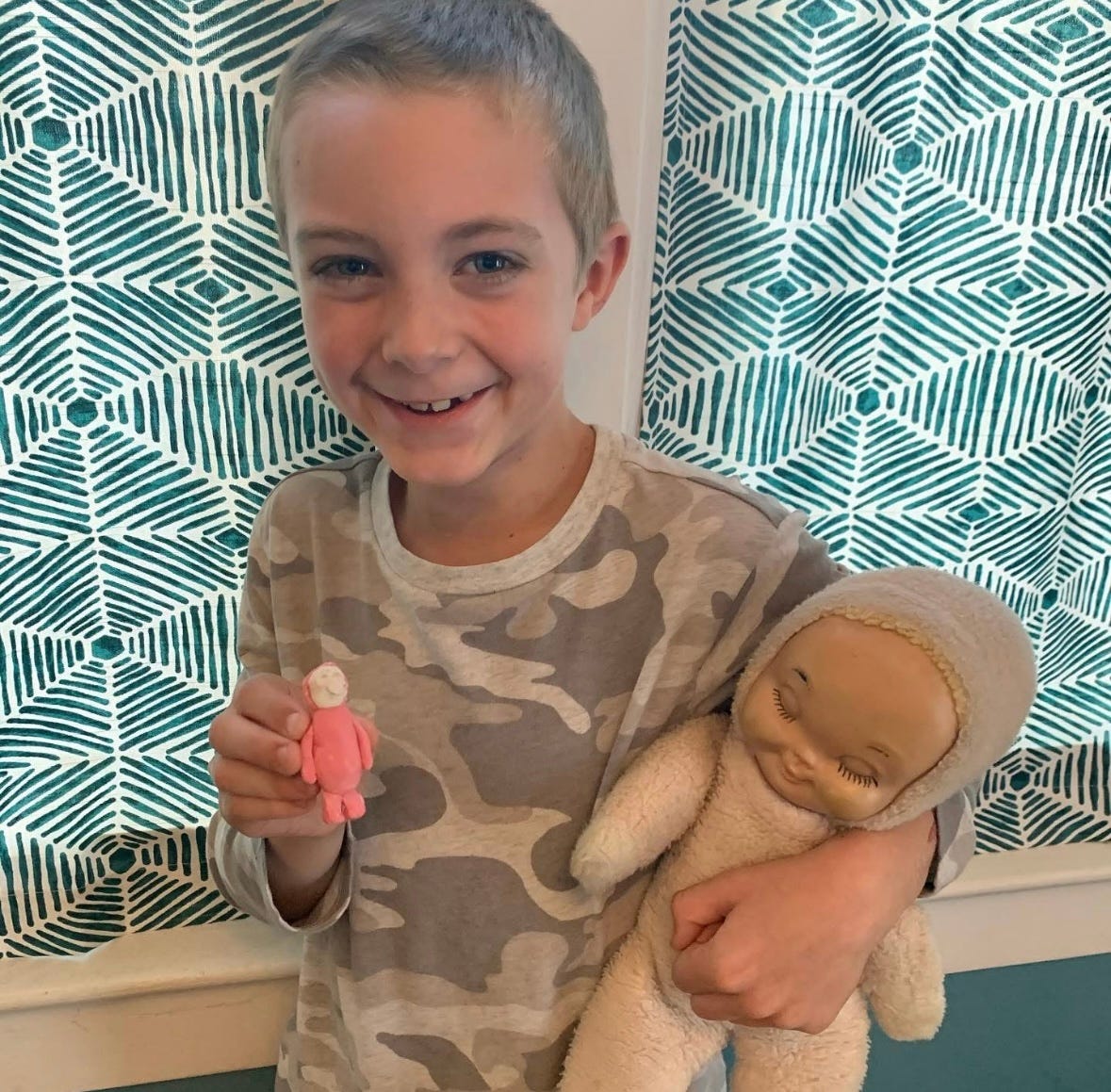
First, a little about what drew me to this poem. As I say in the introduction, I had a beloved doll as a child that I took everywhere with me. “Pink Baby” was adopted by my son when he was small (see photo at the end of the post), but now that he’s outgrown her, she’s sitting on a bookshelf in my writing room.
When I first read “Lamb,” I was immediately drawn to the juxtapositions and associative leaps in this poem, which feel close to the child’s mind to me. The line breaks and use of punctuation in this poem slow the poem down, so the details unfold bit by bit. This feels intuitively right to me. When children tell stories, sometimes the relationships between details—the causality—isn’t clear. Near the center of the poem, for example, are these three lines, all and-stopped with punctuation, which slows the reader down:
My dad had a beautiful overcoat.
The lamb’s white fur got smudged.
My brother was a baby,
Here we get three statements, all simply structured (subject/verb: my dad, the lamb’s fur, my brother), but all are possessive, and a closer look reveals the links in the chain. In the speaker’s memory, the father’s “beautiful overcoat” is linked to the lamb’s coat getting dirty. The lamb getting smudged links to the baby brother being passed around to strangers. There is so much vulnerability in these images and scenes. The “one eye” brought up in line two is circled back to toward the end: the child putting his finger into the socket of the missing eye as he would fall asleep. Talk about a vulnerable image! (It’s interesting, too, that the advice about pickpockets in the second sentence of the poems, lines three through seven, is about being stripped of things that are conventionally valuable—money, a watch—but what the child is most concerned about is something sentimental and therefore priceless.)
Having a beloved doll or blanket as a child is visceral—we hold them close, and we remember those smells and textures—and it’s that is made clear in the final line of this poem. Here the lamb is nearly resurrected—brought back from the overhead bin, where we are told her had to go. (Certainly the child would have preferred to keep him close.) The lamb is returned, freezing, but safely back in the arms of the child, who kisses him. Not it—him. There is something so lovely, nearly romantic, in the closing. I’m relieved for both the lamb and the child, that they are reunited. The subtle end rhyme of “bin” and “again” is such a beautiful touch, too.
Some very good news: Richie Hofmann’s new book of poems, The Bronze Arms, is out in February! You can preorder it now, and I hope you’ll join me in doing so. I’m a huge fan of his work.
Thanks for reading, and for listening to The Slowdown, and for being here. Last year was the busiest year I’ve ever had—a real whirlwind that was joyful and productive, but also full of challenges. I look forward to slowing down a bit, writing a lot, and spending more time in this space in 2026. I wish you and yours all the best in the new year.
Happy listening, & reading, & (I hope!) writing—
Maggie
Oh my gosh--that photo of Rhett and the clay "Pink Baby" is priceless! Thank you for including it!
Love and appreciate this behind-the-scenes look! Hope there's more to come ☺️